Voices for Democracy and Justice is an independent platform run by independent journalists, activists and human right defenders amplifying stories about human rights and the issues that shape communities across Madagascar.
We cover politics, governance, environment, climate justice, education, health, inequality, media freedom, corruption, and community rights. We give space to voices that are often ignored or silenced, while remaining independent from political and institutional influence.
Support independent journalists telling stories that matter.
Contact: contact@voicesofordemocracyandjustice.org
Who Controls Knowledge in the Age of AI? Wikimania Paris 2026 Puts Wikipedia’s Future in Focus
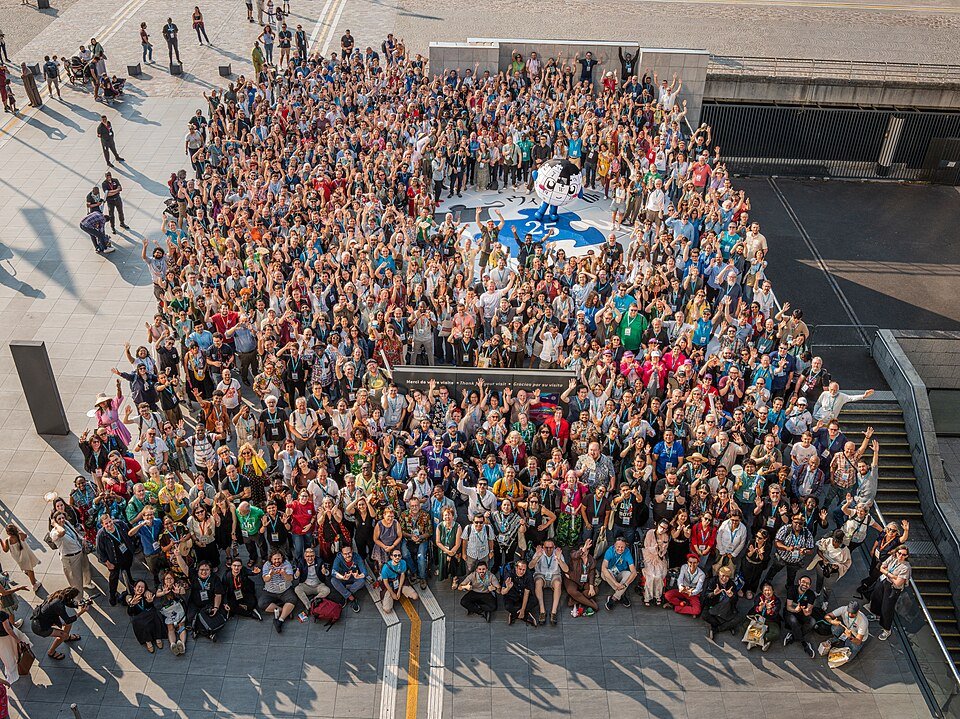
Participants of Wikimania 2026: Credit photo: Wikimedia Foundation

As Wikipedia marks 25 years, thousands of contributors gather in Paris to confront disinformation, artificial intelligence and the growing struggle to keep reliable knowledge open to the world.
PARIS — Every day, millions of people turn to Wikipedia for answers. They consult it to understand breaking news, research unfamiliar subjects, prepare for exams and make sense of a complicated world. Yet behind the familiar search box lies a less visible reality: an international network of volunteers working to ensure that knowledge remains accessible, verifiable and free.
That network came together in Paris from 21 to 25 July for Wikimania 2026, the annual global conference of the Wikimedia movement. Coinciding with Wikipedia’s 25th anniversary, the gathering brought together approximately 1,250 people in person and nearly 2,000 online, placing a fundamental question at the centre of the debate: who will shape the future of knowledge as artificial intelligence transforms the way information is created, distributed and consumed?
Under the theme “Liberté, Équité, Fiabilité” — Freedom, Equity, Reliability — Wikimania Paris was more than a celebration of an internet institution. It was an opportunity to examine the responsibilities and vulnerabilities of a global information resource at a time when trust in digital information faces mounting challenges.
A global knowledge project at a crossroads
When Wikipedia launched in 2001, the idea of building a free online encyclopedia through the collective efforts of volunteers represented an ambitious experiment. A quarter of a century later, the project has grown into one of the world’s most influential information resources, with more than 67 million articles across over 300 languages.
Its scale is remarkable, but its underlying principle remains straightforward: knowledge should not be the exclusive property of governments, corporations or institutions. People should be able to access information, examine its sources and contribute to a shared body of knowledge.
That principle, however, requires constant work.
Wikipedia depends on volunteers who write articles, verify references, correct errors, challenge bias and monitor changes. Its openness makes participation possible, but it also exposes the platform to vandalism, manipulation and the deliberate insertion of false information.
Wikimania Paris brought these tensions into focus. For its organisers and participants, the anniversary was not simply an occasion to look back at a technological success. It was a chance to consider whether the collaborative model that sustained Wikipedia for 25 years can remain resilient in a rapidly changing information environment.
Artificial intelligence and the question of trust
Few developments are reshaping that environment as quickly as generative artificial intelligence.
AI systems can summarise complex subjects, answer questions in conversational language and produce information at extraordinary speed. Yet they can also generate inaccurate claims, invent sources and present misleading statements with apparent confidence. As more people rely on AI-generated summaries instead of consulting original sources, questions about attribution, accuracy and accountability become increasingly urgent.
For Wikipedia, the challenge is twofold.
First, contributors must protect the quality of the encyclopedia itself. False information and fabricated references can be difficult to identify, particularly when they are introduced at scale. Second, Wikimedia projects must navigate a digital ecosystem in which their content can be reused by search engines and AI systems, sometimes without readers ever visiting the original articles.
The relationship between Wikipedia and AI is therefore more complicated than a simple contest between human knowledge and machines. Wikimedia communities have used automated tools for years, including systems that help detect vandalism and support editorial work. The emerging challenge is to determine where AI can assist human contributors without undermining the principles of transparency, verifiability and community oversight.
Discussions at Wikimania reflected the importance of these questions for the movement’s future. The central issue is not merely whether machines can produce information, but how society can distinguish dependable knowledge from convincing misinformation — and who should be responsible for that distinction.
Freedom, equity and reliability are interconnected
The conference’s three-part theme offered a framework for examining the broader stakes.
Freedom means preserving access to information and the ability to participate in its creation. Restrictions on online expression, political pressure and barriers to accessing knowledge can weaken the public’s ability to understand events and hold institutions accountable.
Equity asks whose knowledge is represented. Information resources cannot fully serve humanity if entire languages, cultures, communities and historical experiences remain underrepresented. Expanding participation requires more than translating existing articles; it means enabling people to document their own histories and contribute perspectives that might otherwise be overlooked.
Reliability requires transparent processes, credible sources and sustained editorial scrutiny. Wikipedia’s collaborative model does not guarantee that every article is correct. Its strength lies in making revision possible and allowing contributors to question, improve and correct published information.
These principles reinforce one another. An encyclopedia cannot be truly comprehensive if entire communities are excluded, nor can open access fulfil its promise if readers cannot assess the credibility of what they encounter.
The challenge is especially significant in a multilingual world. Wikimedia’s Paris conference featured programming in French, English, Spanish and Arabic, reflecting an effort to make international participation more accessible. The language question is not merely logistical: it is central to who gets to create knowledge and whose voices are heard.
The human infrastructure behind the internet
Wikipedia is often treated as a website rather than as a community. Wikimania offers a different perspective.
The annual gathering brings together editors, researchers, developers, educators and advocates who work across different countries and cultures. Their contributions vary widely, from improving an article’s references to developing technical tools or documenting cultural heritage.
Many of these tasks take place quietly and without financial compensation. An editor may spend hours correcting a citation, documenting a neglected historical subject or helping a newcomer understand the rules of the platform. Individually, these efforts can appear modest. Collectively, they sustain a resource used by people around the world.
The significance of meeting in person is particularly clear for a movement whose work is largely conducted online. Contributors can exchange practical experience, discuss disagreements and build relationships that support collaboration long after a conference ends.
The Paris edition also highlighted the importance of younger contributors and international participation. According to the Wikimedia Foundation’s post-event account, approximately 34 per cent of in-person attendees were under 35, while an estimated 66 per cent came from outside Northern and Western Europe.
Those figures point to a movement extending beyond its traditional geographical centres, although meaningful global participation still depends on addressing unequal access to travel, technology, funding and opportunities to contribute.
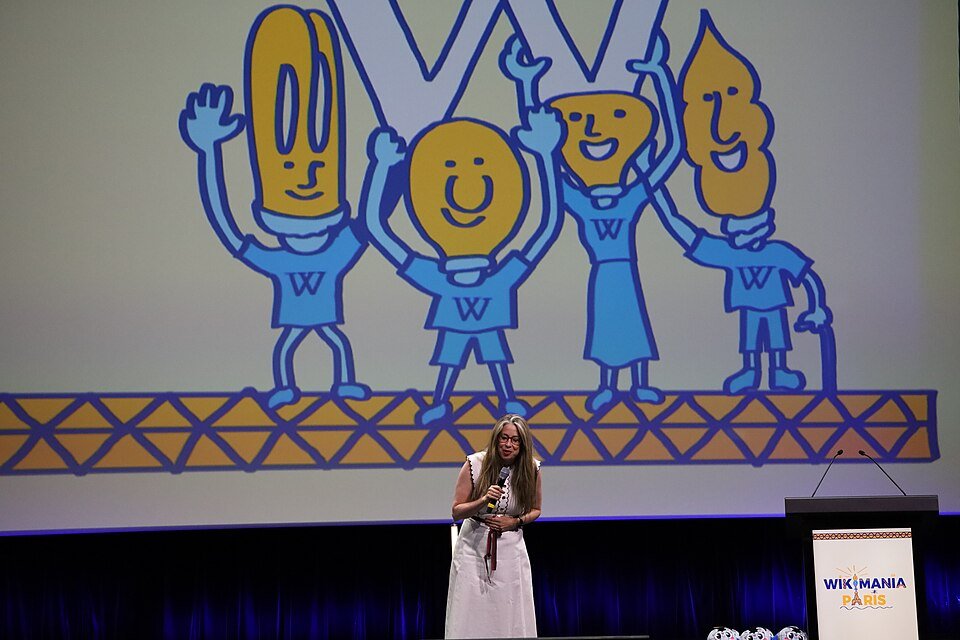
Wikimania 2026 opening ceremony with Bernadette Meehan, CEO of Wikimedia Foundation. Credit photo: Ahmad Ali Karim

Beyond Wikipedia: a question for democratic societies
The stakes extend well beyond one encyclopedia.
Journalists use Wikipedia as an entry point for research. Students use it to explore unfamiliar subjects. Researchers and readers follow its references to discover further sources. AI systems and search engines also draw on information from Wikimedia projects.
This widespread use creates both influence and responsibility. Wikipedia is not a substitute for independent reporting, primary documents or specialist research, and its articles should not be treated as infallible. But its emphasis on citations, public revision histories and collaborative scrutiny offers a useful case study in how information can be produced and challenged in public.
At a time when misinformation can travel rapidly across social platforms and synthetic content can blur the distinction between evidence and fabrication, the processes through which knowledge is established matter as much as the information itself.
Wikimania’s discussions therefore touched on a broader democratic question: how can societies preserve shared sources of information when people increasingly encounter different versions of reality?
There is no single technological solution. Reliable information depends on institutions, editorial standards, public literacy and communities willing to invest time in checking claims. It also requires protecting the conditions under which people can exchange information freely and challenge established accounts.
What comes after the anniversary?
The closing of Wikimania Paris did not resolve these questions. Nor could a five-day conference settle the future relationship between artificial intelligence, public knowledge and digital rights.
Its significance lies instead in bringing the people responsible for maintaining an important part of the digital commons into a shared conversation about what comes next.
The next phase will require translating discussion into practical work: improving tools for contributors, strengthening the detection of false information, expanding representation across languages and cultures, and establishing clearer expectations for the responsible reuse of openly available knowledge.
It will also require recognising that free knowledge is not self-sustaining. Wikipedia may be accessible at no cost to its readers, but producing and maintaining reliable information demands time, expertise, infrastructure and sustained human effort.
Twenty-five years after its creation, Wikipedia faces a paradox. The technologies transforming how people discover information may also increase the value of a resource built on human collaboration, transparent sources and continual correction.
The question is whether those principles can retain their place in a digital world increasingly shaped by automated answers, commercial platforms and information produced at industrial scale.
Wikimania Paris 2026 offered no easy answer. It did, however, make one point clear: the future of free knowledge will depend not only on what technology can generate, but also on whether people remain willing and able to question, verify, share and improve what the world knows.
In that sense, Wikipedia’s next 25 years may be determined less by the sophistication of the machines surrounding it than by the strength of the human community working behind the screen.
Editorial note: This feature is based on published information about Wikimania Paris 2026 and the Wikimedia movement. It is written as an independent-style media article, not an official Wikimedia statement. No invented eyewitness scenes or fabricated quotations have been used.
Raveloaritiana Mamisoa
Donate and Support Our Work
To continue this important work independently and reach more people, we need your support. Your donations, partnerships, volunteering, and help in spreading the word allow us to remain active and make a meaningful difference.
Your support helps us promote democracy, defend human rights, strengthen communities, and amplify voices that are too often unheard.
If you would like to support Voices for Democracy and Justice, please contact us for information about how to donate:
Email: contact@voicesofordemocracyandjustice.org
We will be happy to provide you with the available donation methods and answer any questions you may have.
Why Every Voice Matters in a Democracy
Democracy depends on participation. In times of injustice, silence helps the oppressor not the oppressed. Every voice no matter how small has power.
Voices for Democracy and Justice exists to amplify those often unheard. Whether you're voting, protesting, creating, or simply speaking out, you're part of the movement for change.
Raise your voice. Justice and democracy need all of us.
FOLLOW OUR SOCIAL MEDIA


